
Content Gap Analyzer – Find Missing Keywords & Unlock SEO Growth If your competitors are ranking above you on Google, there is a strong chance they are targeting keywords you are missing. A Content Gap Analyzer helps you discover those…
Content Gap Analyzer – Find Missing Keywords & Unlock SEO Growth
If your competitors are ranking above you on Google, there is a strong chance they are targeting keywords you are missing. A Content Gap Analyzer helps you discover those missing keyword opportunities so you can create smarter, data-driven content and increase organic traffic.
The Content Gap Analyzer Tool at
http://taskhug.com/tools/seo-tools/content-gap-analyzer
is a powerful free SEO tool designed to identify keyword gaps between your website and competitor domains.
This guide explains what content gap analysis is, why it matters, and how to use the TaskHug tool step by step to grow your rankings strategically.
What is Content Gap Analysis?
Content gap analysis is the process of comparing your website’s keyword rankings with competitor websites to identify:
- Keywords competitors rank for but you don’t
- Topics your content is missing
- Untapped ranking opportunities
- Low-competition keyword gaps
- Content expansion opportunities
By targeting these gaps, you can increase visibility, improve keyword coverage, and drive qualified traffic.
Why Content Gap Analysis is Important for SEO
Modern SEO is competitive. Simply publishing content is not enough. You need strategic keyword targeting.
A Content Gap Analyzer helps you:
- Discover high-value missing keywords
- Identify competitor content strengths
- Improve topical authority
- Plan data-backed content strategy
- Increase organic traffic growth
Without gap analysis, you are guessing. With it, you are optimizing intelligently.
How to Use TaskHug Content Gap Analyzer (Step-by-Step Guide)
Follow these steps to perform a complete content gap analysis:
Step 1: Visit the Tool Page
Open the official tool:
http://taskhug.com/tools/seo-tools/content-gap-analyzer
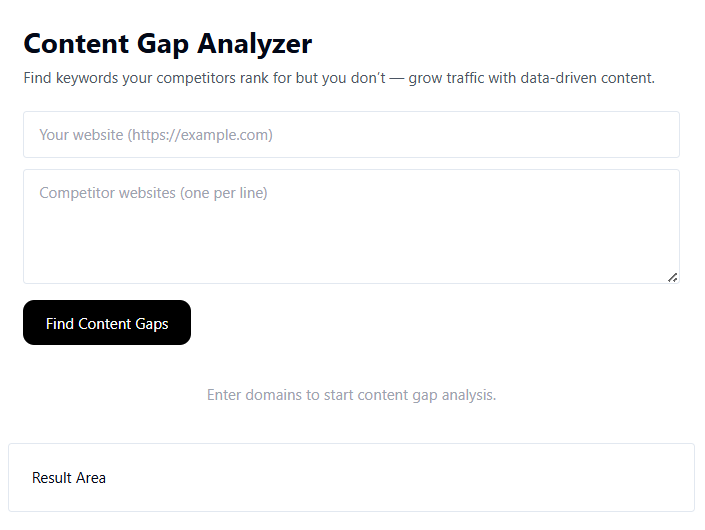
Step 2: Enter Your Website URL
Input your domain or webpage URL in the first field.
Step 3: Add Competitor URLs
Enter one or more competitor domain URLs that rank in your niche.
Step 4: Click “Analyze”
Press the analyze button to start comparison.
Step 5: Review the Keyword Gap Report
The tool generates:
- Missing keyword opportunities
- Shared ranking keywords
- Competitor-only keywords
- Search volume insights
- SEO opportunity suggestions
Step 6: Export or Plan Content
Use the results to:
- Create new blog posts
- Expand existing articles
- Optimize landing pages
- Improve keyword targeting
This structured process ensures your content strategy is driven by competitive intelligence.
Best Practices for Content Gap Optimization
To maximize results:
- Target long-tail keywords first
- Focus on search intent alignment
- Create in-depth, structured content
- Update older content with missing keywords
- Build internal links between related pages
- Monitor rankings regularly
You can also combine this tool with the following TaskHug SEO tools for complete optimization:
- Google Rank Tracker
http://taskhug.com/tools/seo-tools/google-rank-tracker - SEO Competitor Analysis Tool
http://taskhug.com/tools/seo-tools/competitor-analysis - Full SEO Audit Tool
http://taskhug.com/tools/seo-tools/seo-audit - Website Health Checker
http://taskhug.com/tools/seo-tools/website-health-checker - Google SERP Analyzer
http://taskhug.com/tools/seo-tools/serp-analyzer
Using these tools together creates a full SEO workflow from research to ranking improvement.
Internal Linking Strategy for TaskHug
To improve SEO authority across your website, implement this internal linking strategy:
1. Link Related SEO Tools Together
Each SEO guide should cross-link to:
- Content Gap Analyzer
- Rank Tracker
- SERP Analyzer
- Backlink Checker
- Domain Authority Checker
- Broken Link Checker
2. Link Productivity & Utility Tools Naturally
Within SEO content, add contextual links to:
- Image Compressor (for optimizing blog images)
- Video Trimmer (for optimizing embedded video content)
- EMI Calculator (finance niche blogs)
- BMI Calculator (health niche blogs)
- YouTube SEO Optimizer (video creators)
This strengthens topical clusters and improves crawl depth.
3. Use Keyword-Rich Anchor Text
Examples:
- “analyze keyword gaps”
- “track Google rankings”
- “perform full SEO audit”
- “check website health”
Avoid generic anchors like “click here”.
Who Should Use Content Gap Analyzer?
This tool is ideal for:
- SEO professionals
- Bloggers
- Affiliate marketers
- Digital agencies
- E-commerce owners
- Content strategists
- Website owners
If you publish content regularly, content gap analysis is essential.
Common Mistakes to Avoid
- Copying competitor content directly
- Ignoring search intent
- Targeting only high-volume keywords
- Not updating existing content
- Skipping internal linking
SEO growth comes from strategic execution, not duplication.
How Content Gap Analysis Improves Rankings
When you consistently target missing keywords:
- Your topical authority increases
- Your keyword coverage expands
- Your organic impressions grow
- Your click-through rate improves
- Your competitors lose ranking advantage
It is one of the most powerful competitive SEO techniques.
Conclusion
A Content Gap Analyzer is not just a keyword comparison tool. It is a strategic growth engine for organic search success.
If you want to uncover hidden keyword opportunities and outrank competitors, start using the free tool at:
http://taskhug.com/tools/seo-tools/content-gap-analyzer
Combine it with other TaskHug SEO tools and productivity tools to build a complete digital optimization ecosystem.
Consistent analysis, structured content planning, and smart internal linking will help you achieve long-term SEO growth.